This was supposed to be a post about ALT-C in Glasgow, but I’ve neglected this blog for some time now, so this post will cover all of the conferences that I participated in this past year. I’ve gotten in the bad habit of just adding them to the list and sitting quietly with my ideas and reflections in my Notes app. With social media being so fragmented, it all feels like shouting into the void right now anyway. I’m trying my best with LinkedIn, but it doesn’t suit me particularly well. I don’t like to tag people and annoy them with notifications, and the hyperbolic hashtags are too cringey for me, and if I ever share a picture of myself with my slides…well, send help. So, we’re going to do this the old fashioned way…
The truth is, I’ve participated in some really edifying and sustaining events in 2025. One of my PhD supervisors, Eamon Costello, hosted the Education after the algorithm: Co-designing critical and creative futures symposium at DCU in February, with a Critical Studies in Ed Tech meeting held the previous day on campus. Neil Selwyn has shared a report from the global meeting proceedings. Clare Thomson travelled over and we facilitated a new workshop, ‘Embedding sustainability literacies in postdigital learning design’, in which participants created zines based on the workshop prompts. We developed an OER based on the artefacts we collected. This is the video output:
I was invited to host the panel session with Rachel Fitzgerald, Juliana Raffaghelli, and James O’Sullivan. After the three presentations, we had a thoughtful conversation on the ethics and practicalities of AI in HE, and I was delighted to meet Juliana a few months later again in Zurich. It was also an unexpected and very welcome surprise to meet Sukaina Walji for the first time in person. I had no idea that she was going to be in Ireland, and I was very lucky to see her again a few months later at OER in London. Sukaina has always been kind enough to accept my invitation whenever I would ask her to join panels, etc.
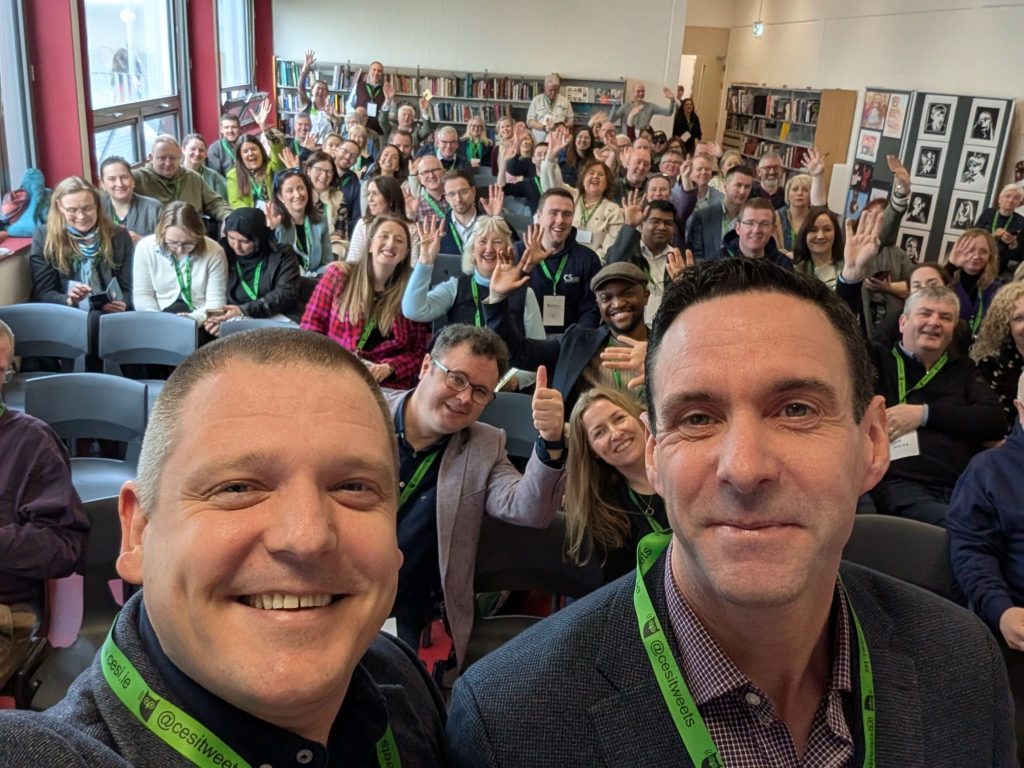
As CESI chair, I hosted the annual conference on 1st March in Limerick. While the conference is always a complete blur when you’re working, this year was even more so. I blinked and it was nearly dark and the day was over. We were joined by Enda Donlon to deliver a joint keynote with Peter Tiernan (DCU). Both Enda and Peter are involved in the Erasmus+ PAIDEIA project to equip teachers with skills to integrate AI into their teaching.
Peter also hosts the Let’s Talk Education Research podcast at DCU, which has become a favourite mine as a new PhD researcher in his school.
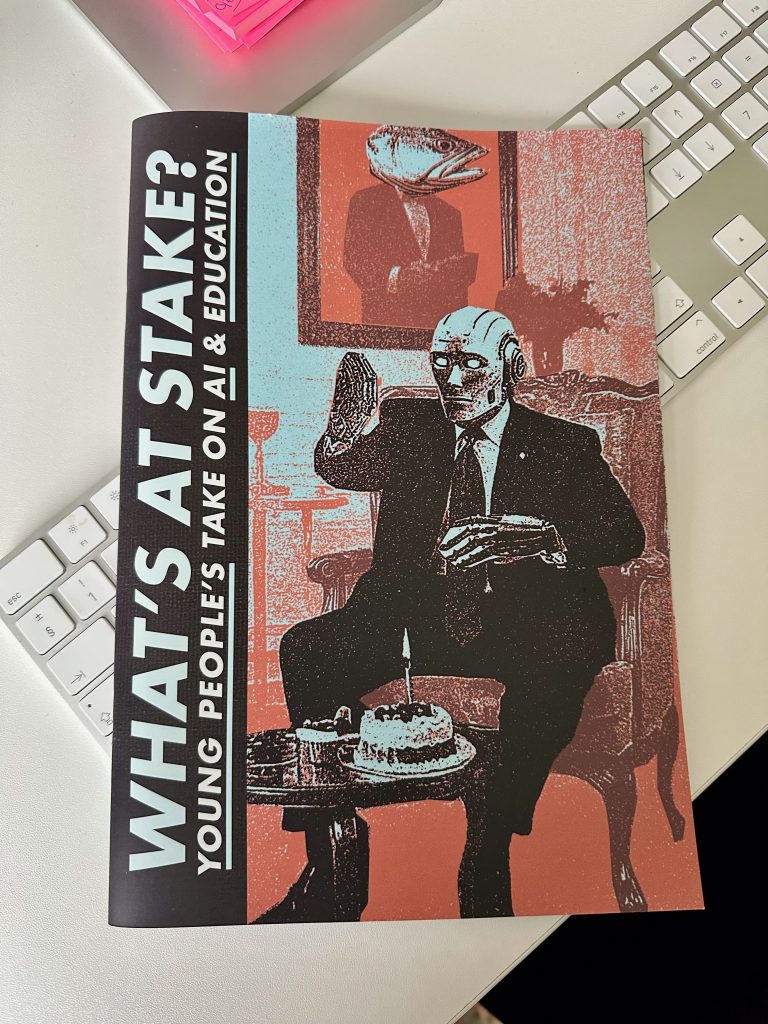
The Irish Learning Technology Association’s (ILTA) annual conference took place in May in Waterford, and it’s always a calendar highlight as a space to catch up with old friends and new. I was particularly delighted to finally meet Jen Ross in person after my time on the PgCert in Digital Education in Edinburgh. Jen sent me home with a copy of the What’s at Stake? Young People’s Take on AI & Education zine, and she also shared the Imagining AI Futures for Education resource created as part of the AI futures for Scottish education project in her keynote address.
It was also a joy to meet Colm O’Neill (SETU) and hear about his research, EdTech as climate criminal, and I was delighted to meet him soon after again in Zurich.
As the conference closed, it was lovely to be able to share the news that Rob Lowney and I would be co-chairing the 2026 ILTA EdTech conference in Dublin City University. More on that later…
One of the calendar highlights of my year was attending and presenting at the inaugural European Conference on Critical Edtech Studies (ECCES) in Zurich in June. Based on the organising committee alone, I had my hopes up that this would be a special event, and a unique space to bring the wider critical edtech community together. I arrived in Zurich the afternoon before the conference, and fortunately for me, the affordable old town hotel that I booked was just a short walk away from the Cabaret Voltatire. As a young student, I had discovered the Dada movement through Greil Marcus’ Lipstick Traces in one of my English modules. In the book, he elegantly weaves together tales of 20th century rebellion through various artistic movements, mainly Dada and punk. Over the next next few days, I wondered if there was some parallel between the Dadists taking the stage in the Cabaret Voltaire in the summer of 1916 to subvert societal conventions that glorified war, and the convergence of critical edtech scholars over one hundred years later to share research and insights against a new backdrop of global polycrisis. Or, perhaps I was reaching to find parallels…
Landed in Zurich today for the European Conference on Critical EdTech Studies and managed to fulfil of my teenage dreams – visiting the birthplace of Dadaism at Cabaret Voltaire. I spent a few hours looking at the exhibits, reading in the Dada Library, and immersing myself in the space. #ECCES
— Kate Molloy (@kate-molloy.net) June 17, 2025 at 8:57 PM
[image or embed]
However, I was reassured that my thinking wasn’t too far off after finding at least one other delegate who drew a comparison to the storied first Sex Pistols gig:
The three days were intense, and the programme was packed. It was a delight to have the opportunity to meet some scholars that I admire like Petar Jandrić, Sarah Hayes, Janja Komljenovic, and Luci Pangrazio. I was also pleased to find that I was presenting in the same session as Markus Deimann, who I had crossed paths with at my learning design workshop in Digital Pedagogy Lab some years before. In fact, in my own quiet reflections on the conference, I revisited his The dark side of the MOOC – A critical inquiry on their claims and realities paper with fresh eyes as I consider the methodology for my review paper.
I also had the pleasure of meeting some new folks that I hope will remain part of my wider PLN for years to come, including Janine Arantes (Victoria University, Melbourne), Lyndsay Grant (University of Bristol), Jennifer Feldman (Stellenbosch University), and Svenja Bedenlier (Friedrich-Alexander-University Erlangen-Nürnberg). Perhaps the most interesting aspect of the conference beyond its rich programme was its overall vibe. As an early career researcher, I found it incredibly welcoming and supportive. For a ‘critical’ conference, I witnessed an encouraging, collegiate community of peers. The social programme did help a great deal. It’s not often that one swims in Lake Zurich after a barbecue at a Swiss castle or has access to mojitos on tap during post-conference canapés. Felicitas Macgilchrist’s keynote on the final morning, Critical Edtech Studies: What are we doing and where are we going? was another highlight. While I’ve been in the critical space for some time, I’m not sure I’ve ever seen anyone examine the movement’s trajectory and future with that depth.
I was in Zurich last week for the first European Conference on Critical Edtech Studies. I was fortunate to present on some early PhD work, make new connections, and enjoy the city and surrounds. Sincere thanks to the organisers for hosting, and for bringing this valuable community together. #ECCES
— Kate Molloy (@kate-molloy.net) June 22, 2025 at 2:23 PM
[image or embed]
I was home in Ireland for just two nights before I headed back to the airport to head to OER 25 in London with Sharon Flynn. I was running a new workshop that Clare Thomson and I developed, ‘Fighting the good fight: Go rogue or go home’. Sharon was facilitating a workshop reviewing ALT’s Framework for Ethical Learning Technology without co-author Natalie Lafferty, so Javiera Atenas and I stepped in to assist. Sadly, I didn’t have much left in my battery for a social programme, so I had an early night while the GO-GN cohort went to dinner. I had hoped to sneak away to the Kurt Cobain Unplugged exhibit as well, but that didn’t materialise, sadly.
Managed to make it one piece to #OER25 in London this week. I was on hand to deliver a workshop developed with @slowtech2000.bsky.social and assist with workshop on @altuk.bsky.social Framework for Ethical Learning Technology. Workshop materials: bit.ly/GoRogueOER25
— Kate Molloy (@kate-molloy.net) June 28, 2025 at 2:15 PM
[image or embed]
I revised our ‘Go Rogue’ workshop for the next two conferences, the Civics of Technology conference, and OER Revisited, which were both online. The CoT conference is a must attend given its accessibility and the work that their community is facilitating more widely. Do sign up for their newsletter, at the very least. The ‘Revisited’ OER/ALT conference are also serving to create a more accessible conference space in moving online with significantly reduced rates. This the the current version of our workshop:
Finally, we’re on to the 2025 ALT conference in Glasgow, which was the point of this blog post in the first place and a shining example of how easily sidetracked that I get. Matt Cornock blogged some timely updates from the conference (day one, day two), and I was pleased to see his reflections on our presentation. I realised that having Clare there to present with provides an audience with so much more insight into our work than I can ever articulate on my own.
Gabi Witthaus delivered a moving, in-depth keynote on critically examining our learning design practices. It was a treat to share a drink with Joe Wilson, and dinner with Gabi before flying home. I also had the pleasure of meeting Natalie Lafferty in person for the first time. We sat together through a variety of workshops on the second day, and while I’m over-simplifying so I can finish this post, I came away realising that I am not alone in my bewilderment on the current edtech landscape. As a field, we remain fixated on endless digital innovation and transformation and a continuous need to reinvent the wheel with often little acknowledgement of past work or existing resources. There is so much work to build upon — we could save so much in terms of resources if we could restrain our drive for endless progress and innovation.
It was useful to take some time to participate in the ALT Strategy 2025-30 session as the community plans ahead for changing times. Speaking to Susan Martin and Keith Smyth about ALT more broadly drove home the importance of learning communities and how they shape us, and how the ALT community can self-sustain.
While I arrived in Glasgow the evening before the conference with great intentions, I never made it to the Glasgow Zine Library or Monorail Music as planned. Perhaps next time…and I have gotten truly terrible at taking photos, so please accept this trippy little video I created in their absence.
Our slides are from the session are available below, and a commentary paper on this topic is hopefully on its way soon.
As mentioned previously, I’ll be co-chairing the ILTA EdTech conference in 2026 with Rob Lowney (DCU). The 2026 conference, ‘EdTech You: Digital Learning From How to Who’, also marks the 25th anniversary of ILTA conference. Having hosted previous events on the St. Patrick’s campus in DCU, it feels a bit like a home coming for both of us. The call for proposals is now open, and we’re looking forward to seeing you in Dublin next June.
As I attempt to move playlists from Spotify to another platform (I’m open to suggestions), here is a YouTube version of my overall 2025 playlist, edited for travel to ALT-C. It’s a bit Glasgow heavy in parts given that I finally got to see The Vaselines over the summer.
Part of me has hesitated to post this as it doesn’t do justice to all of the presenters, speakers, and good people I’ve met and learned from along the way this year. In an uncertain world, the networks and communities that I contribute to and participate in help sustain me, even if I don’t do shout outs too often. It is within these communities that we grow and thrive, and I’m so appreciative that I spent my time this year in good company. The time, resources, and environmental impact of travel to conferences shouldn’t be taken for granted. Adding papers and presentations to the larger list is well and good, but it’s the active participation in these communities where the true value remains.
The featured image on this post is by Andrius Banelis and is licensed under a Creative Commons-Attribution-NonCommercial-ShareAlike 4.0 International license (CC-BY-NC-SA).
